Urban accessibility diagnosis
The 15-minute city
Which everyday opportunities — shopping, learning, care, leisure, work, reuse and repair — can be reached from each of Cancún's 264 superblocks on foot, by bicycle and by car, and how the calculation is built step by step.
In one sentenceIdentifies which superblocks lack everyday functions within walking distance, and which one is missing, to guide facilities, land use and mobility.
Spanish original: Ciudad de 15 minutos
How much city fits in fifteen minutes?
The separation between housing, jobs, education, care, shopping and leisure shifts onto people the daily cost of connecting a fragmented territory.
The diagnosis turns accessibility, as recognised in Mexican law, into measurable territorial conditions to support planning in Benito Juárez.
Key findings
Shopping dominates; learning is scarce
Of 28,212 opportunities, 48% are for shopping and 2.5% for learning.
The mode changes the reachable city
The median resident reaches 986 opportunities on foot in 15 minutes, 2,051 by bicycle and 12,813 by car in 8 effective minutes.
Where the walkable city is missing
240,700 people live in superblocks with very low overall walking access (index 0–20).
Approach
Step 1
Generate a regular 100 m grid of origins (21,022 points) and assign each to its superblock.
Step 2
Snap each origin to the network and compute isochrones: 15 minutes on foot and by bicycle, 8 effective minutes by car.
Step 3
Merge isochrones by superblock and count classified destinations in each dimension.
How to read it
- It is an exploratory estimate over 264 superblocks: the index normalises counts across superblocks and is not a canonical version.
- The superblock is an analytical aggregation unit; it does not evaluate the superblock as an urban form.
- Counts do not measure the quality, capacity or opening hours of destinations.
- Car travel uses 8 effective minutes with historical congestion, not observed trip times.
Data
Superblocks
264 superblocks with 2020 population (866,953 residents).
Street and cycling network
Navigable graphs by mode for isochrones.
Business directory 2025 and municipal public space
28,212 opportunities classified into six dimensions of daily life (563 activity codes).
What supports the method
- Giovanni Vecchio (2020)Cumulative opportunities within a time threshold is the most used measure in Latin America, and thresholds should be discussed (p. 13 and 17).
Paraphrased; page numbers refer to the PDF consulted. The library is in Spanish.
What you just saw
A 100 m grid of origins, isochrones by mode on the network and a count of destinations in six dimensions of daily life.
What else this method can answer
- Which facility brings the most walkable city?
- Which superblocks depend on the car for daily needs?
- How does access change with a new cycle lane or route?
In other places
Replicable with a street network, a business directory and the local planning unit.
Line of work
B · Accessibility, proximity and care →Do you have a similar question in your city?
Describe the problem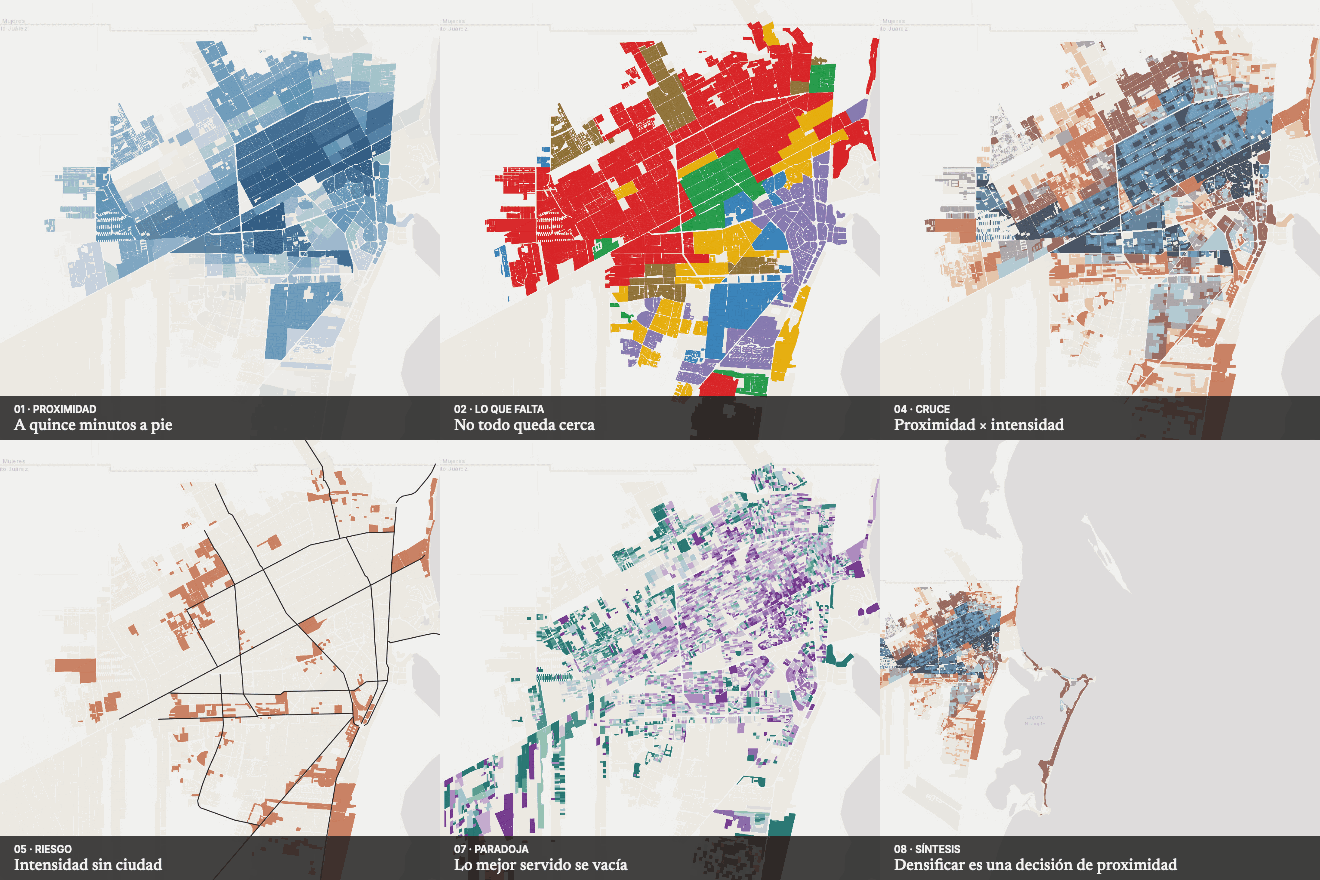 Next in Accessibility and mobilityDensify where there is city?