Emptying, housing and land value
The emptying city
An atlas of the forms of residential emptying in Cancún: where the consolidated city loses residents, how much housing is not permanently occupied, what land prices do and what current zoning proposes there.
In one sentenceSeparates types of emptying that require different policies: replacement, vacancy and loss on appreciating land.
Spanish original: La ciudad que se vacía
Why does a growing city empty out?
Cancún grows outwards while its consolidated city loses residents. But emptying is not one thing: some blocks change use, others are left vacant and others decline, almost always on land that is getting more expensive.
Telling these trajectories apart matters because each one calls for a different response: more building rights alone do not bring residents back.
Key findings
The consolidated city is not growing
In comparable blocks population went from 589,486 to 583,910 between 2010 and 2020. Growth happens in new blocks.
The core concentrates the loss
The urban core accounts for 70% of residents lost in comparable blocks.
More than one in eight homes not permanently occupied
In 2020 there were 30,633 vacant dwellings and 8,441 for occasional use: 13.1% of the private housing stock.
Emptying does not make land cheaper
59% of blocks losing population (with market data) are in superblocks with robust appreciation 2016–2023; in 199 of 204 superblocks market value exceeds cadastral value.
Zoning follows activity
Current zoning assigns a weighted floor-area ratio of 2.89 where activity replaces housing and 2.36 where housing is vacated or the city declines.
Approach
Step 1
Compare 2010–2020 population only in blocks that existed in 2010, so expansion is not confused with the consolidated city.
Step 2
Separate forms of emptying with explicit rules: replacement by activity, housing vacancy, decline and residential loss without other signals.
Step 3
Cross each form with land-price trajectories and the gap between market and cadastral value.
Step 4
Read which intensity current zoning assigns to each type of emptying.
How to read it
- The population balance excludes new blocks: it is not the municipal balance.
- Market prices exist by superblock; blocks inherit that value.
- Occasional use is not the same as vacation rental: the census does not identify platforms or tenure.
- The typology uses explicit rules, not a statistical model or index; policy instruments are presented as questions for discussion.
Data
2020 Population and Housing Census
Occupied, vacant and occasional-use private dwellings by block.
Population 2010–2020
Balance by block, comparing blocks with at least 20 residents in 2010.
Businesses and estimated employment
Business directory 2010, 2020 and 2026.
Land prices by superblock
Market ranges 2016, 2019 and 2023; 2025 cadastral value and reference market value.
Volumetric simulation of current zoning
Maximum and buildable floor-area ratio per lot, aggregated by block.
What supports the method
- (2019)Cancún grew from 277 urbanised hectares in 1975 to 14,495 ha in 2014 and shifted from a linear to a nodal city (p. 81).
Paraphrased; page numbers refer to the PDF consulted. The library is in Spanish.
What you just saw
Block typologies built from population, housing, activity and land value.
What else this method can answer
- Where should the centre be repopulated?
- Which housing is vacant?
- What does zoning propose where the city empties?
In other places
Replicable with two censuses and land values.
Line of work
D · Territorial diagnosis and monitoring →Do you have a similar question in your city?
Describe the problem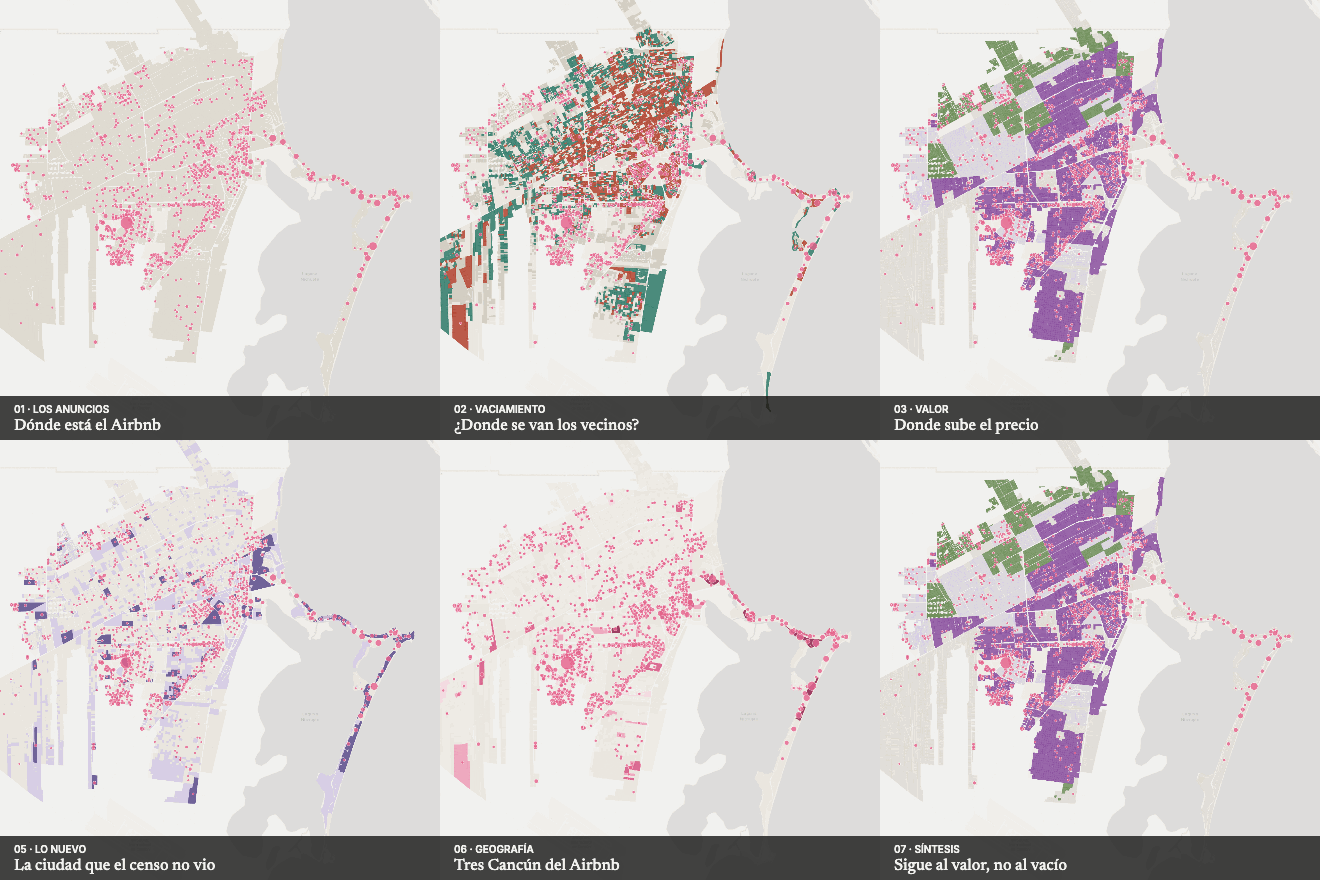 Next in Land, housing and zoningIs Airbnb emptying the city?