Care and mobility analysis
The care commute
How many jobs are lost, on foot and by bus, by someone who must drop a child at day care or school before going to work: the care system as a mobility system.
In one sentenceMeasures the cost of caring in terms of reachable city: a stop at day care removes a large share of accessible jobs.
Spanish original: La jornada de cuidados
How much city does a stop at day care cost?
For millions of women the trip to work starts at the day-care centre or the school.
This atlas measures how many jobs are lost by someone who first has to drop off a child.
Key findings
The care stop reduces reach
In one hour, the median resident reaches 62% of jobs going directly and 40% stopping first at day care.
It is not only distance
The primary school is 8 minutes away, yet stopping there still costs 32% of reachable jobs: the stop forces another wait for the bus.
Where day care is matters
Contrary to expectations, the loss is smaller where female-headed households without cars predominate (39% against 46%): it depends mainly on where day care sits relative to jobs.
Approach
Step 1
Extend the multimodal accessibility model with home → day care or primary school → work chains, including drop-off time.
Step 2
Compare jobs reachable in one hour with and without the care stop from every populated cell.
Step 3
Cross the loss with female-headed households, young children and car ownership.
How to read it
- The directory does not record places, hours, costs or family care.
- The most convenient day care for the trip is assumed, not the one with a place.
- It shares the waiting and speed assumptions of the bus model.
Data
The 'One hour by bus' model
OSM pedestrian network and 35 bus routes.
Business directory 2026
Day care, primary schools and employment.
2020 Census
Children, female-headed households, car ownership.
What supports the method
- Inés Sánchez de Madariaga (2013)Surveys miss short walking trips and chained trips and hide care in other categories (p. 3–4).
- Banco Mundial (2020)Women rely more on public transport and walking, and make more non-work trips (p. 9).
- CAF (2018)In 11 Latin American cities, 65% of those who walk as their main mode are women (p. 5).
Paraphrased; page numbers refer to the PDF consulted. The library is in Spanish.
What you just saw
Chained trips home, day care or school, and work within the multimodal model.
What else this method can answer
- Where should day care go so it does not cut access to jobs?
- Which schedules or routes ease the day?
- Who carries most of the care?
In other places
Uses the same accessibility model plus the location of care services.
Line of work
B · Accessibility, proximity and care →Do you have a similar question in your city?
Describe the problem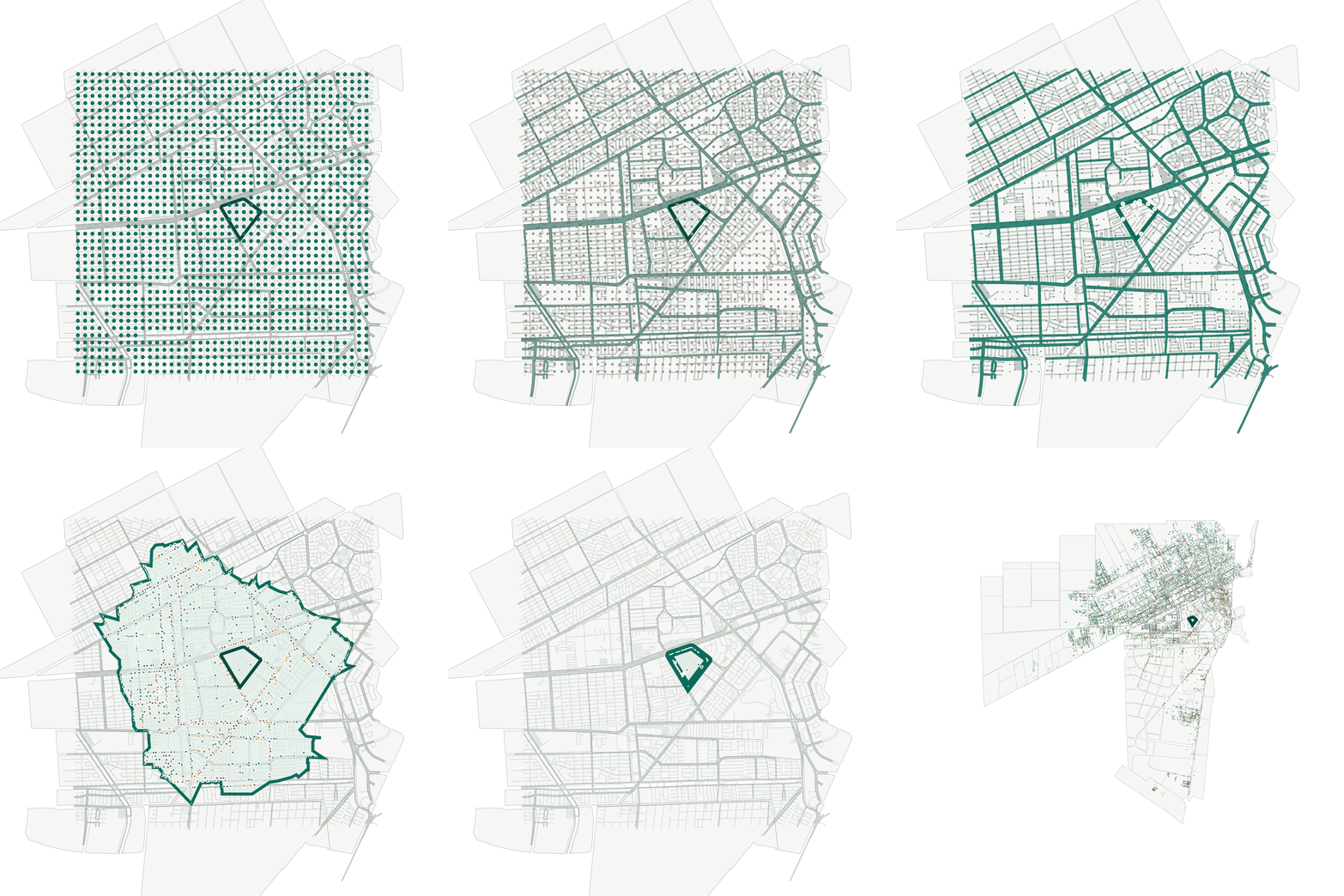 Next in Accessibility and mobilityThe 15-minute city