Back to Mobility and Accessibility
Where something is missing within fifteen minutes, it is almost always culture or health
685,709 people in the six cities lack at least one of the six functions within 1,200 m; where two or more are missing, 93.8% live in the least dense third of the population.
Everyday Proximity Index · Spain · What is missing within a fifteen-minute walk in Spain’s six large cities, and where?
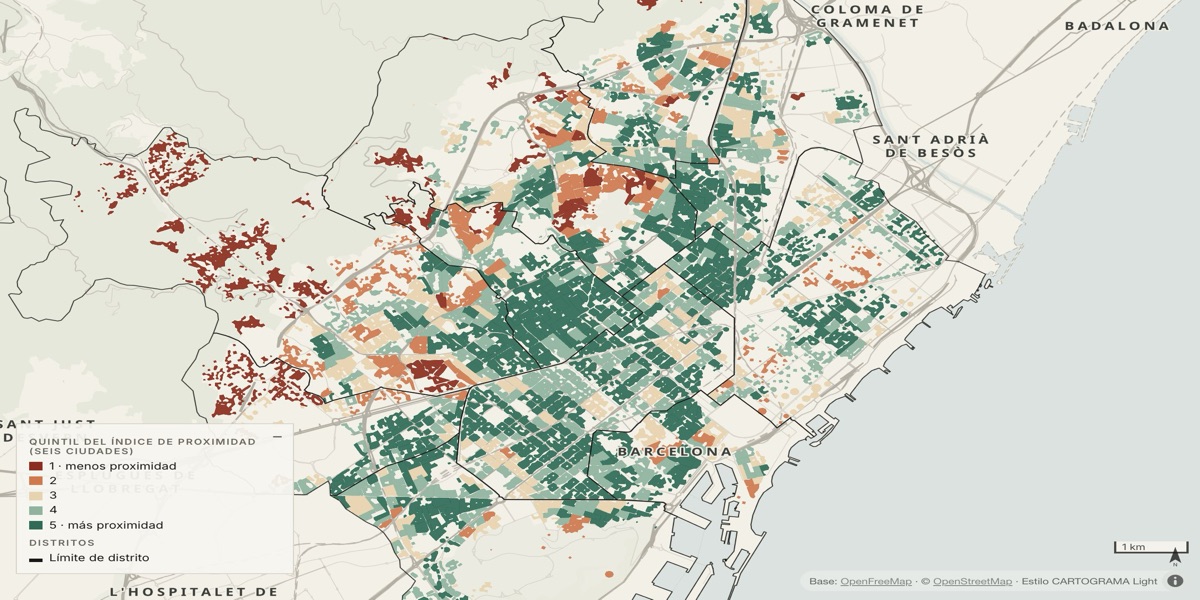
We measured the walking distance along the street network from each starting point on housing to six functions of daily life in Madrid, Barcelona, Valencia, Zaragoza, Seville and Málaga, on a single scale for the six cities. Then we counted what each person lacks within fifteen minutes and read it from the city to the district, the neighborhood and the section.
Read the full documentThe first ten pages, online. The full document is sent by email on request.
What we found
Where something is missing, it is almost always a facility
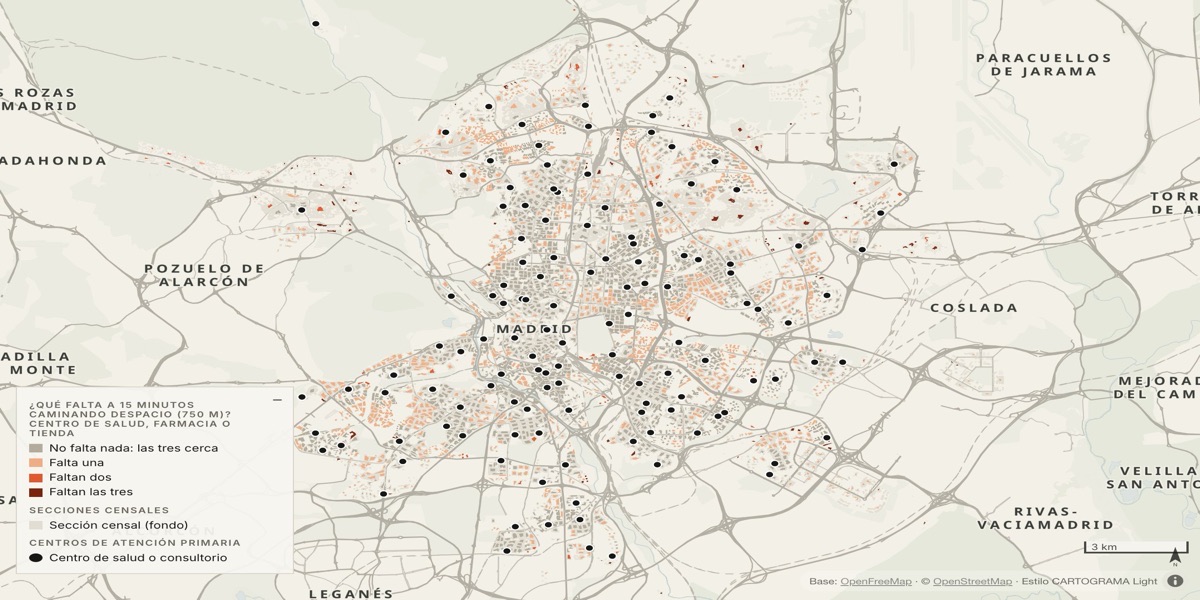
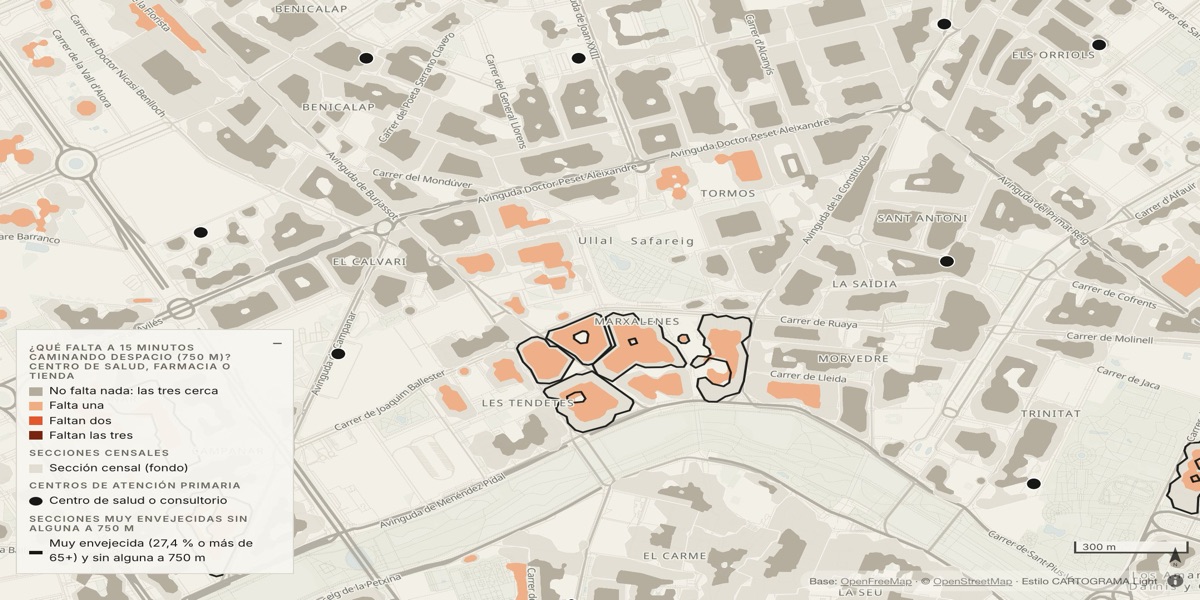
685,709 people, 8.6% of the six cities, lack at least one of the six functions within 1,200 m, and three in four lack just one: culture in 72.9% of cases and health in 24.4%. Of those who lack something, 84.3% have food and transit within fifteen minutes; what they lack nearby is a library, a cultural center or a health facility. Bringing them closer is a facility-planning decision.
Where two or more functions are missing, it is the low-density edge
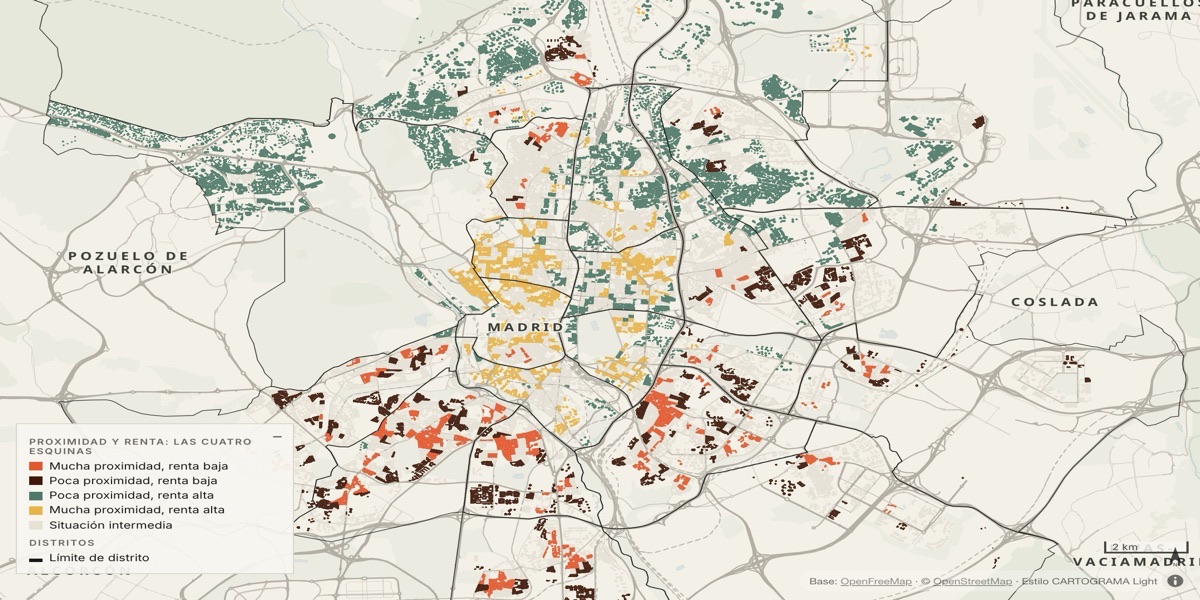
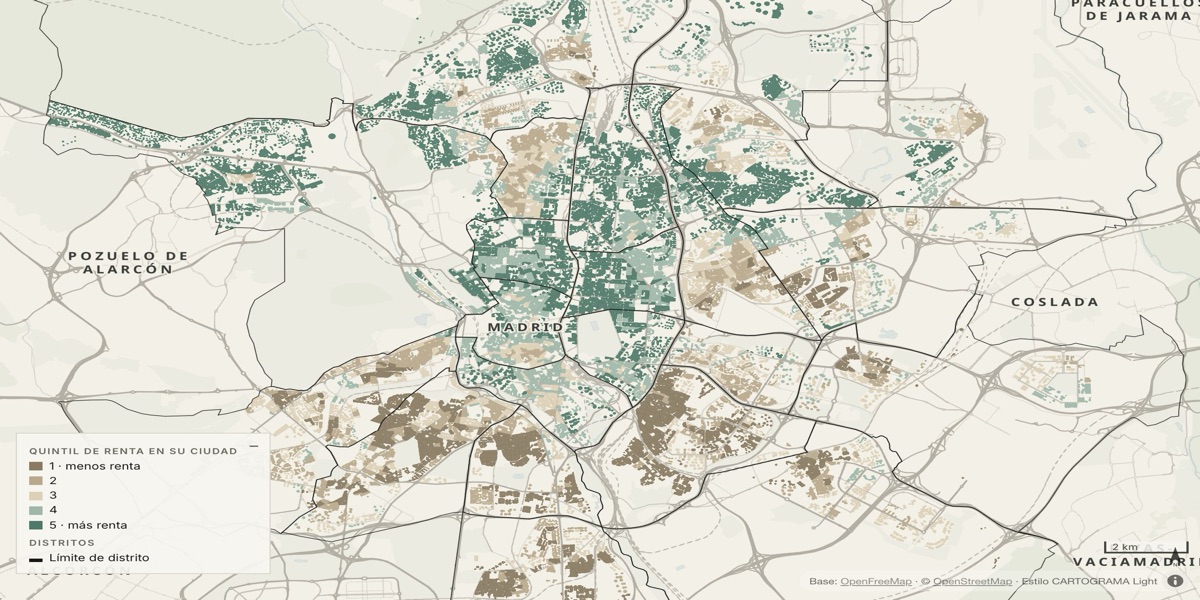
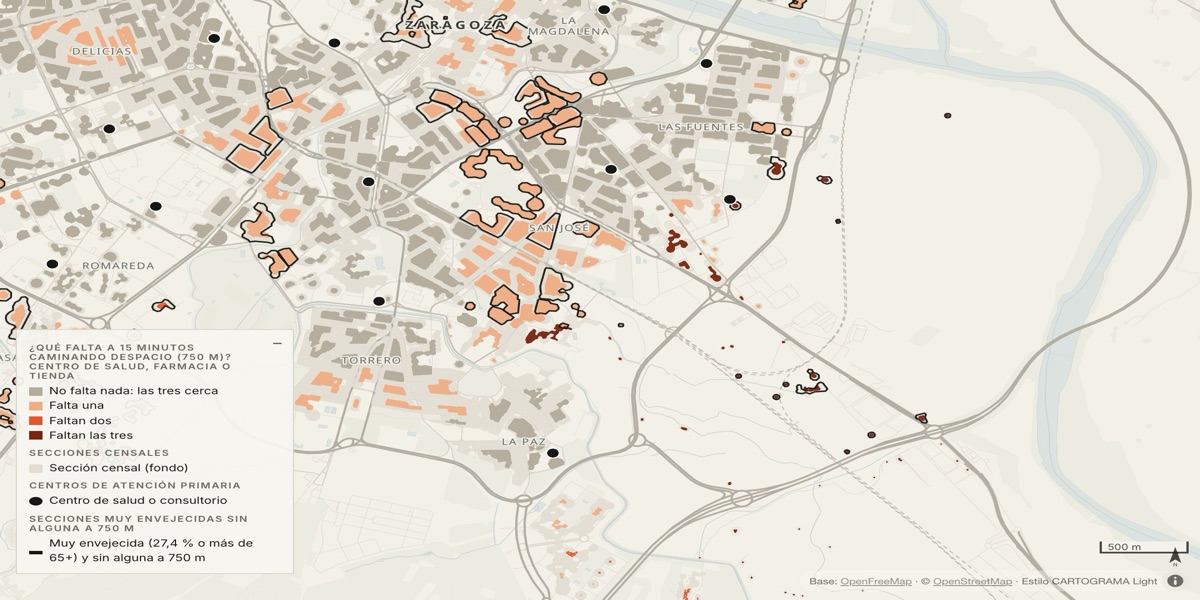
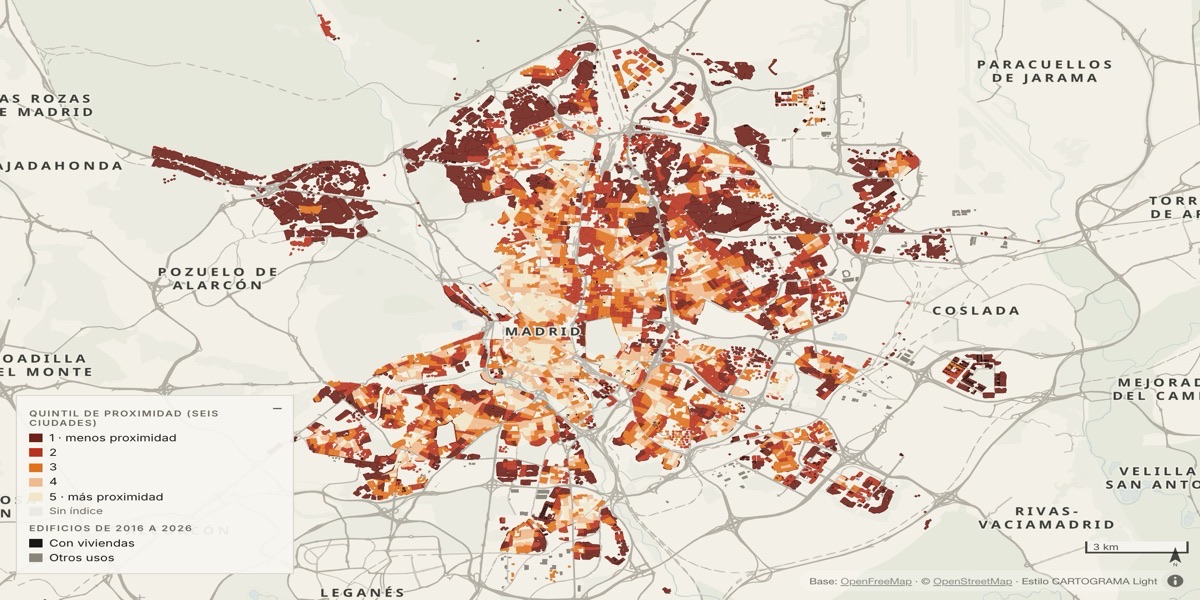
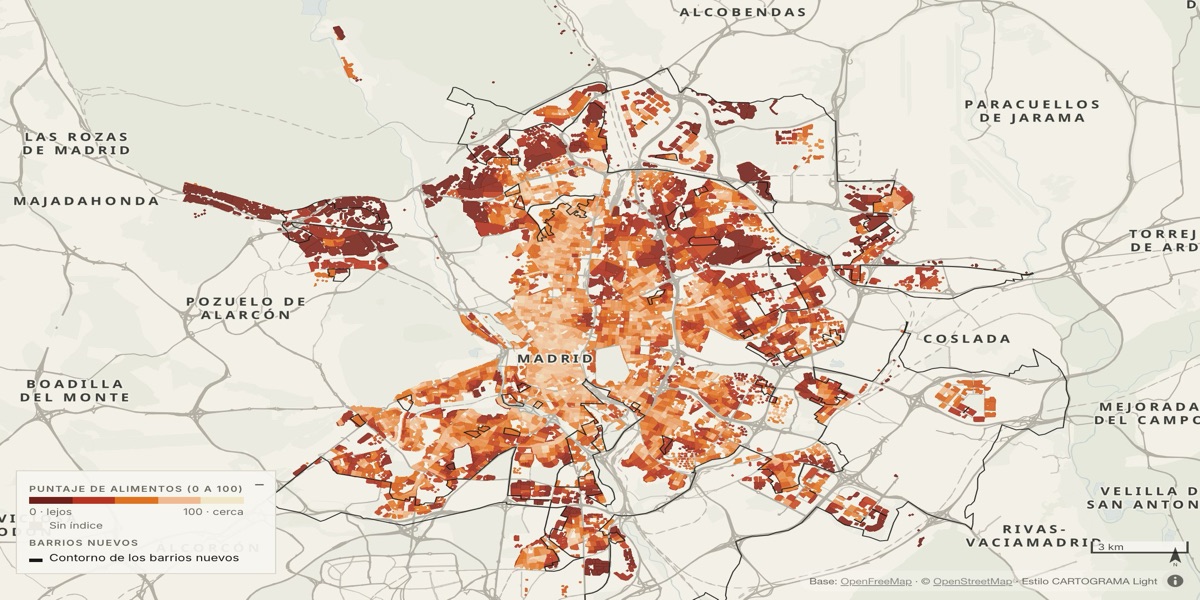
179,829 people lack two or more functions, and 93.8% of them live in the least dense third of the population, in sections with fewer than 216 people per hectare; all 89,350 who lack three or more live there too. Fourteen districts in every city except Barcelona hold 71.8% of these people with 10.6% of the population; in Madrid, Hortaleza accounts for 19,935. Within a single district, the difference is one of neighborhoods: in Moncloa-Aravaca, El Plantío scores 13.3 and Argüelles, 61.4. That is why the target is set by district and measured in each neighborhood.
In dense areas, services need to be closer
441,533 people live in dense sections with little proximity. 90.7% of them have all six functions within fifteen minutes, but farther away: half have health care 568 m or more away and culture 565 m or more away, compared with 296 and 281 m in dense sections with high proximity, about twice the distance. In Seville, only 47.0% of the people in those sections have all six functions; 53.0% lack culture, and 19,521 of them live in Cerro-Amate. In sections of 415 or more people per hectare, each service brought closer reaches many people at once; that is why Cerro-Amate is the place to start.
See it on the map
What we recommend
Set a target for each district: every neighborhood with each function within 1,200 m. First, in the fourteen edge districts where two or more functions are missing, starting with those where the most people are in that situation, Hortaleza, the Rural district of Zaragoza and Moncloa-Aravaca: libraries and cultural and health centers. Then, closer services in dense sections with little proximity, starting with those in Cerro-Amate, where 19,521 people have culture more than fifteen minutes away. The instrument is the land reserved for facilities in the general plan.
The low-density edge lacks facilities; dense areas need closer services. A target for each district, measured person by person, organizes both responses.
More from this project Full research on the index · Measure your neighborhood
Calculation of the proximity index from starting points on housing, from the section to the neighborhood, the district and the city · Madrid, Barcelona, Valencia, Zaragoza, Seville and Málaga, Spain · 2026
Facing a similar problem?
We can run this analysis for your city, with your data and your question.
Relevant for
- Mobility and planning departments
- Road-safety and school-mobility programs
- Care and social-development programs
- International organizations and funders
We also
Related projects
 Where to act first?Who has daily life close by: higher-income neighborhoods or lower-income ones?
 Who has access, and who is left out?How many older people live far from what they most need nearby?
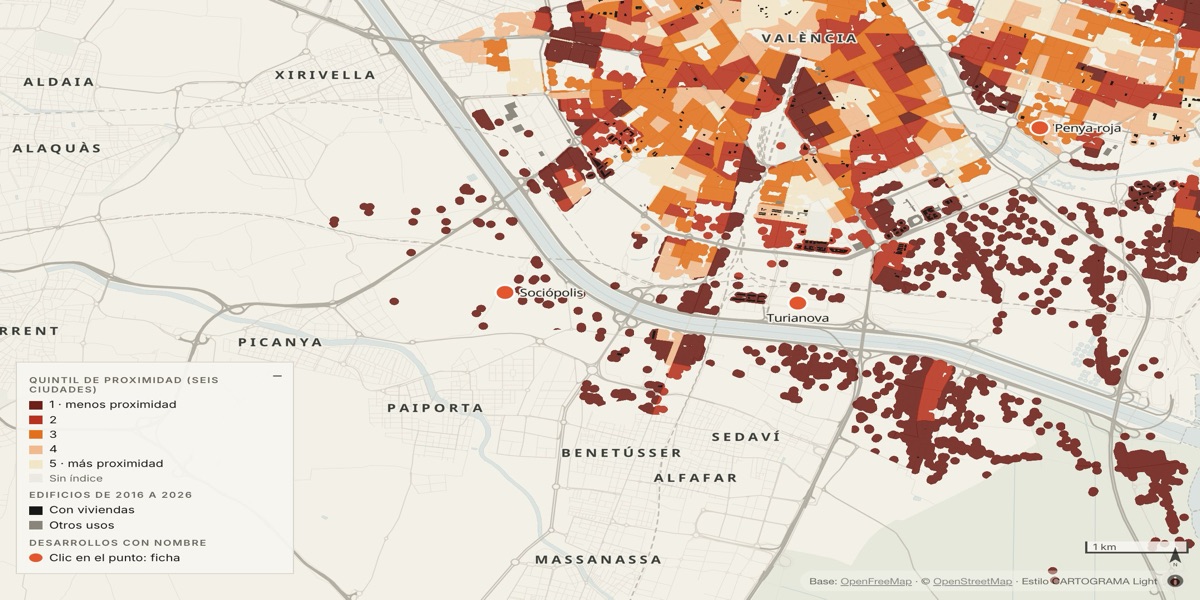
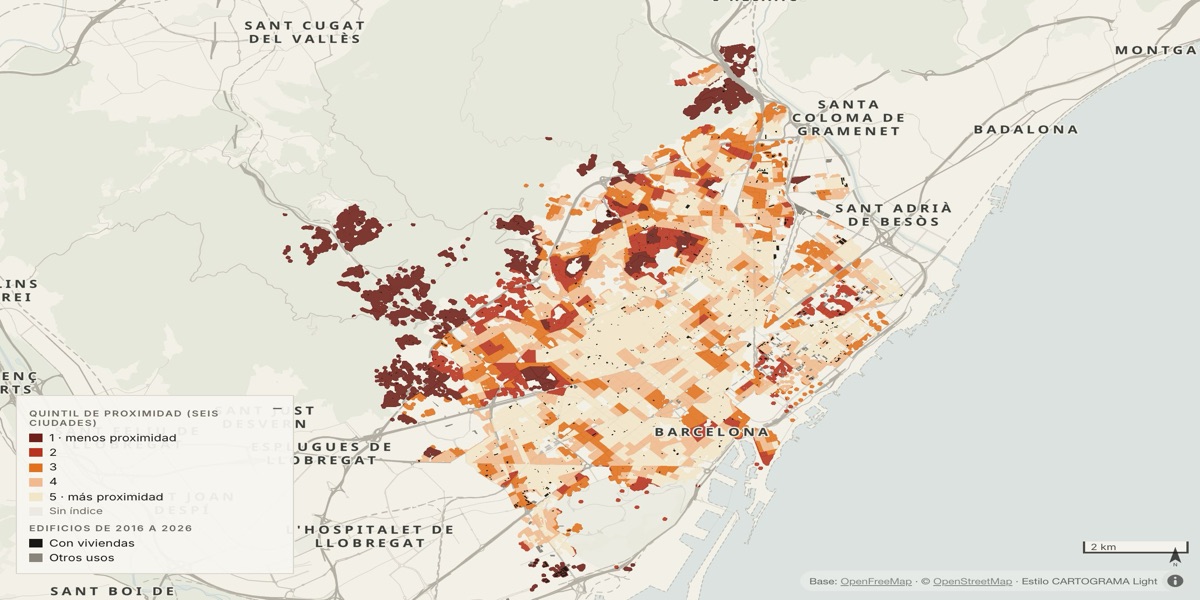 Another scale: Building → CityWhere do Spain’s cities build, and how much proximity do their new neighborhoods get?