Close, but in the sun
Between 12.8% and 22.0% of the daily walk runs along hot, treeless streets; 99.6% of people in Barcelona live within fifteen minutes of a climate shelter, and 19.4% in Seville.
Close, but in the sun · Spain · Where do people walk to daily life when the heat sets in?
What share of the walk to daily life runs along hot, treeless streets in Madrid, Barcelona, Valencia, Zaragoza, Seville and Málaga, and who has a climate shelter within fifteen minutes. On average, between 12.8% and 22.0% of the walk is exposed; 99.6% of the population of Barcelona has a shelter within fifteen minutes, and 19.4% in Seville.
Read the technical noteThe first two pages, online. The full note is sent by email on request.
The problem
The proximity index says how many meters away the shop, the school, the health center or the stop are. In July it also matters where those meters run: whether they go along hot streets without trees, and whether there is a cool place nearby to stop. We measured it route by route in the six Spanish cities with more than 500,000 inhabitants.
What we found
The big difference between cities is where to take shelter
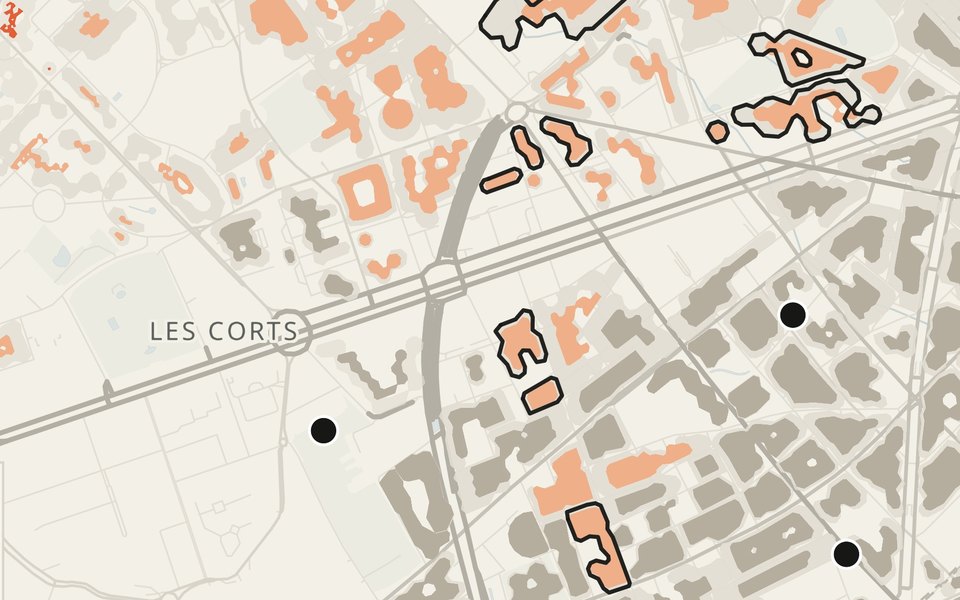
99.6% of the population of Barcelona lives within a fifteen-minute walk (1,200 m) of a climate shelter, 91.2% in Valencia, 89.6% in Málaga and 87.3% in Zaragoza. In Madrid the share falls to 52.8% and in Seville, the city with the hottest everyday street (45.9 °C surface temperature at midday), to 19.4%.
Older people, at their own pace, are farther away
At 3.6 km/h, fifteen minutes cover 900 m. Of the 1,660,292 people aged 65 or over in the six cities, 603,515 have no shelter within that distance. In Seville, 13.1% have one; in Madrid, 43.8%; in Barcelona, 99.3%. Of them, 96,704 also have the most exposed walk in their city.
In the south, those who live farthest from everything also walk more in the sun
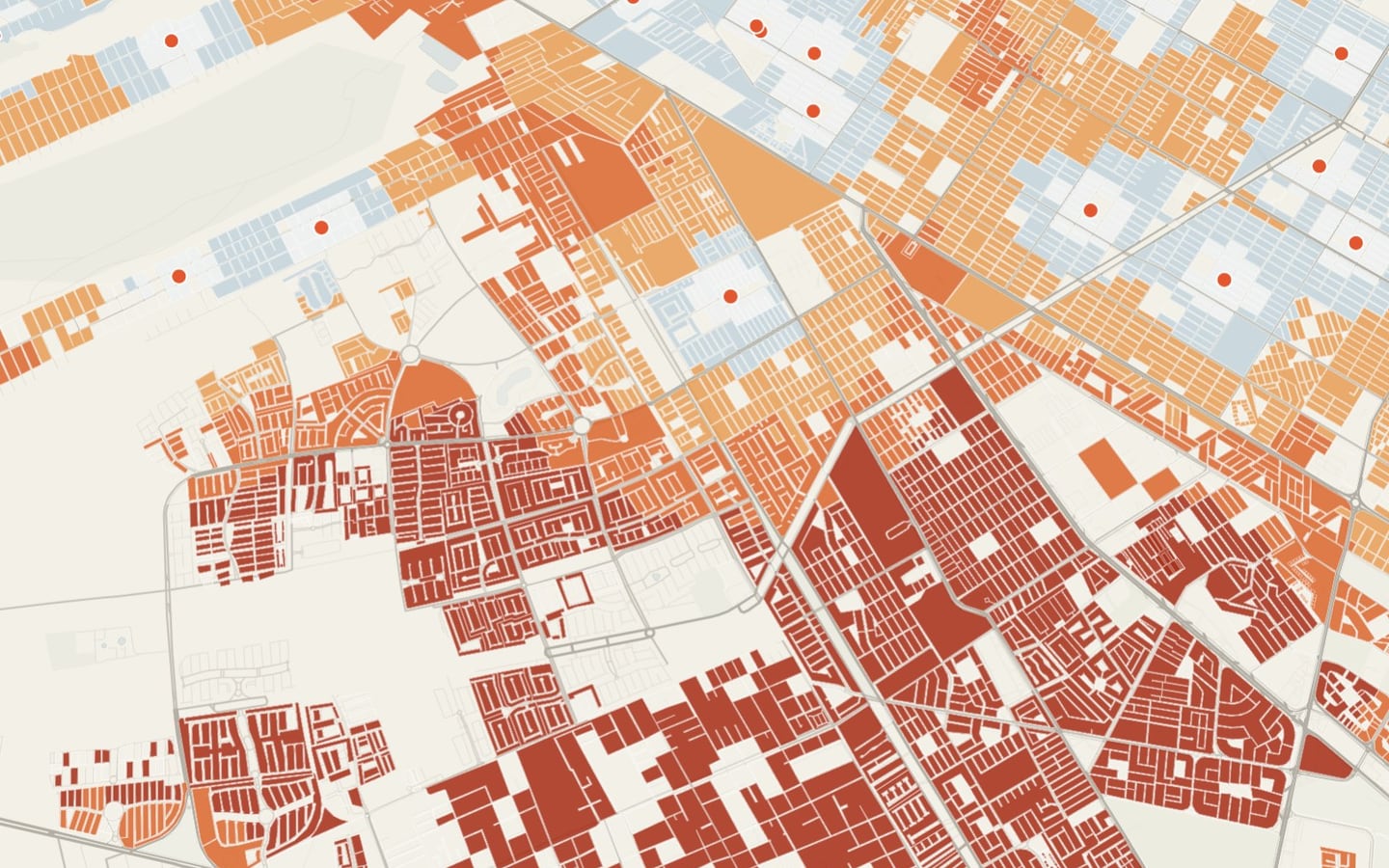
In Seville, sections in the lowest quintile of the index walk 22.8% of their route along hot, treeless streets; those in the highest, 3.4%. In Málaga, 27.8% against 4.0%. These are neighborhoods such as Torreblanca, Parque Alcosa, Bellavista and La Plata in Seville, or Campanillas, Las Manseras and Cortijo Alto in Málaga.
In Zaragoza, the best-served neighborhoods are the most exposed
In Zaragoza the relationship is reversed: the highest quintile of the index has 27.5% of its walk exposed and the lowest, 21.4%. San José, Delicias and Ciudad Jardín are home to 46,997 people in sections with high proximity and highly exposed walks.
Heat and lack of trees go together
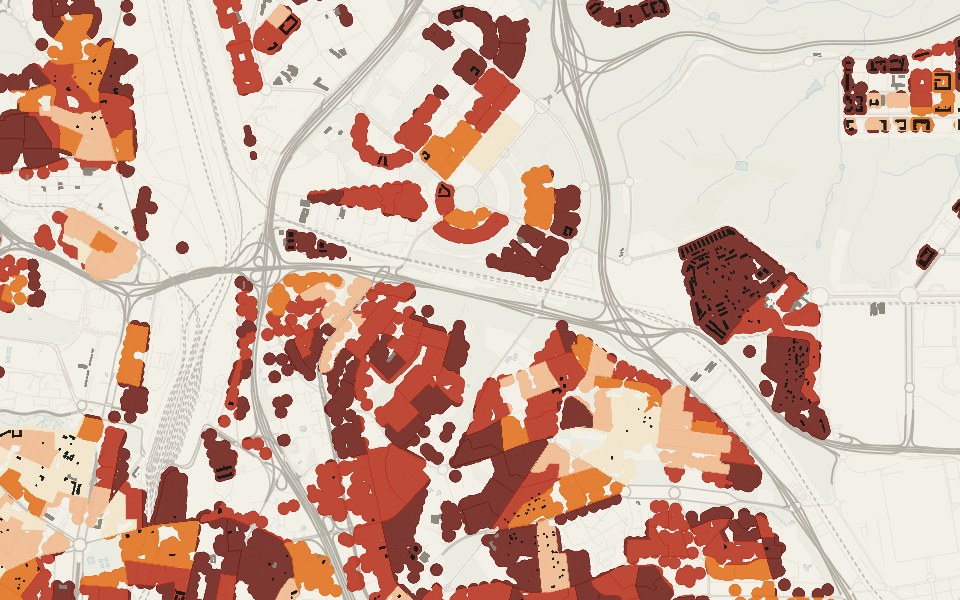
In Madrid, hot segments have 2.2 trees 8 m or taller per 100 m according to the municipal inventory; the rest, 6.2. That is why the result barely changes when shade is measured with the inventory instead of the satellite.
Madrid and Barcelona, neighborhood by neighborhood
Average exposure barely changes across index quintiles. Ensanche de Vallecas is the largest case of low proximity and heat (29,529 people, 60.2% of their walk exposed); in Barcelona, with a shelter close to almost everyone, what is missing is shade on the street.
See it on the map
What we recommend
Start with the sections where older people, highly exposed walks and no shelter within 900 m come together, above all in Seville and Madrid; open existing facilities in summer (libraries, civic centers, markets, senior centers) with afternoon and August hours. In neighborhoods that are already close to everything, such as San José, Delicias and Ciudad Jardín in Zaragoza, prioritize trees and shade on the streets that lead to services.
The fifteen-minute city is also walked in July: being close is not enough if the way runs in the sun and the shelter is far away.
The walking routes of the proximity index, segment by segment, crossed with summer surface temperature, tree canopy and climate shelters · Madrid, Barcelona, Valencia, Zaragoza, Seville and Málaga, Spain · 2026
Facing a similar problem?
We can run this analysis for your city, with your data and your question.
Relevant for
- Public services and public works departments
- Citizen services and innovation offices
- Public safety, coexistence and civic justice
- Traffic and urban management