Back to Mobility and Accessibility
One in nine crosses a fast avenue
How many minors cross a 60 km/h road on the way to the nearest school, and where.
Crossing to Get There · Bogotá · How many children have to cross a fast avenue to get to school?
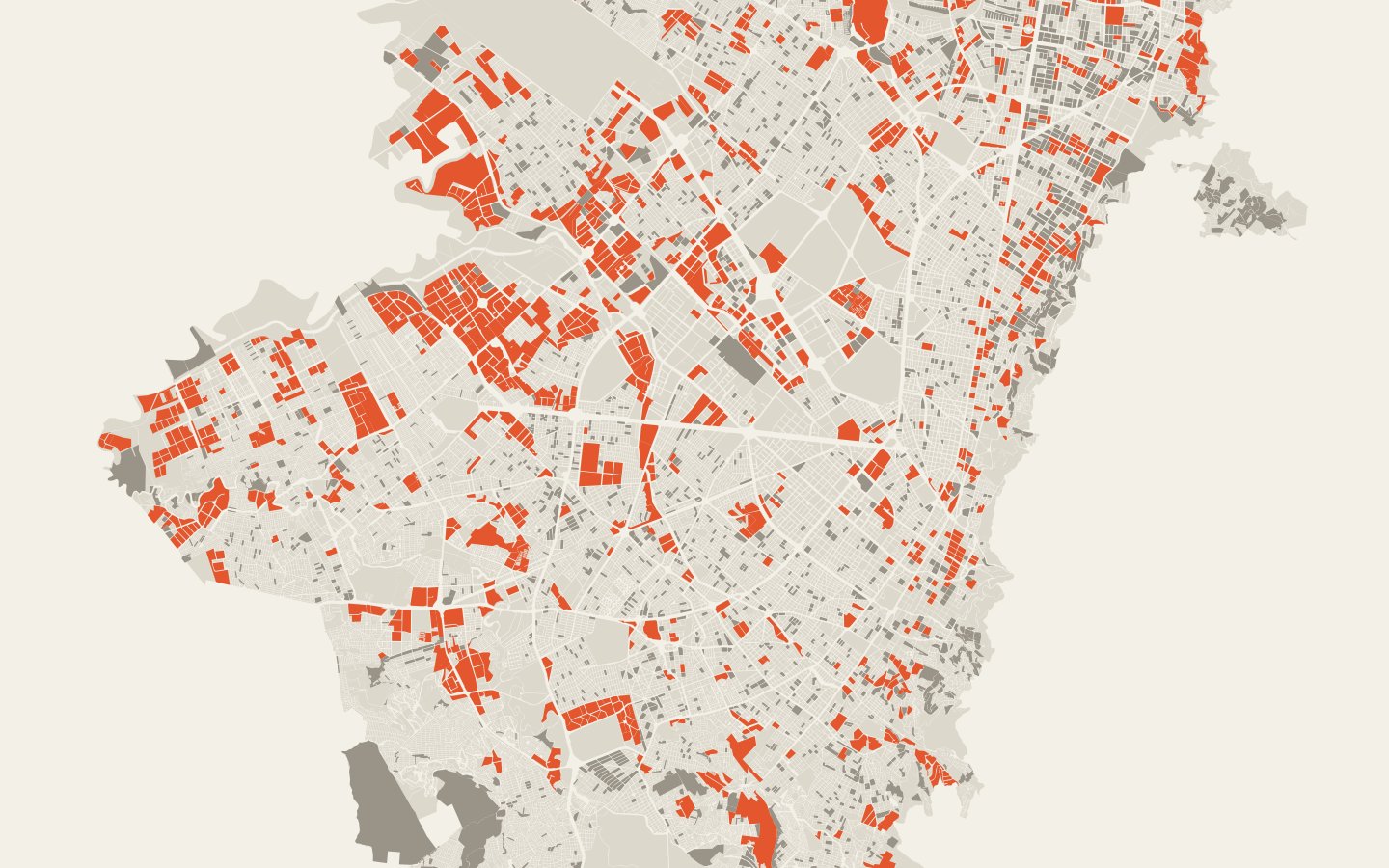
214,365 children and young people aged 0 to 19 (11.6%) cross at least one 60 km/h avenue on the shortest walking route to the nearest school; if only public schools are counted, the figure is 402,444 (21.7%). For most of them, the crossing cannot be avoided with a short detour.
Read the technical noteThe first two pages, online. The full note is sent by email on request.
The problem
The walk to school is the most repeated walking trip in the city. When it crosses a 60 km/h avenue, the risk falls on those least able to judge it. Knowing how many cross, and where, shows which crossings to address first.
What we found
Most of those who cross have no other reasonable route
214,365 people aged 0 to 19 cross a 60 km/h avenue on the shortest walking route to their nearest school. Of them, 143,587 have no route without crossing that is at most 1.25 times longer, and 37,980 have none at all. For them the crossing cannot be avoided: it has to be made safe.
In numbers, the south and the west; in proportion, the expanded center
Because of their size, Bosa, Kennedy, Fontibón and Suba account for 46.6% of the minors who cross a fast avenue. As a share of their minors, Chapinero (40.6%) and Teusaquillo (33.8%) lead, where there are more fast avenues per square kilometer.
Addressing a few crossings is not enough
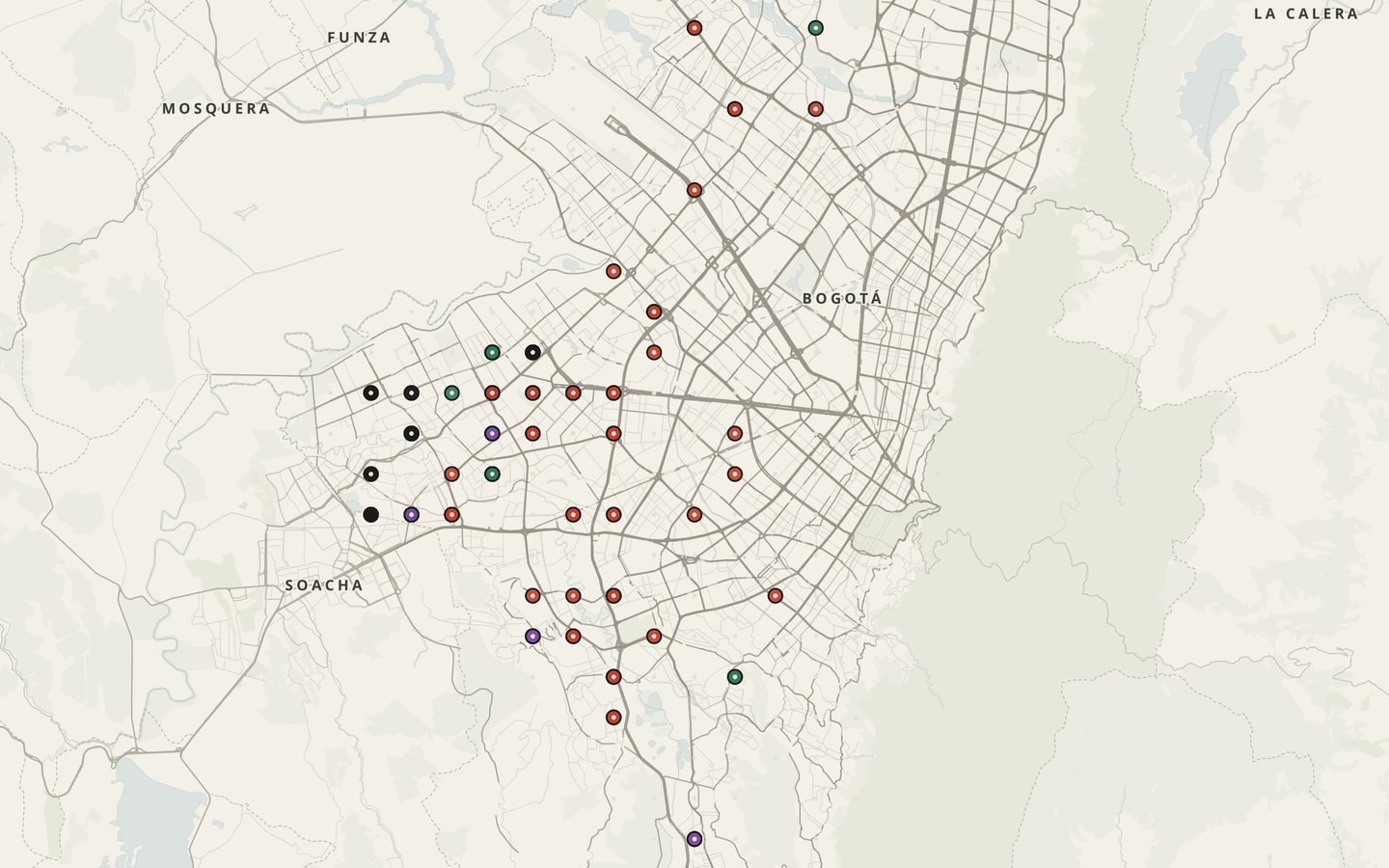
School routes cross avenues at 2,334 points. Covering half of the flow of minors requires addressing 116 of them; in Cancún, 50 were enough. In Bogotá the problem is more spread out and calls for a broad program, not just a few points.
Two lists are needed: one for minors crossing and one for pedestrian crashes
The crossings used by school routes have more pedestrian crashes than the rest: 2.10 per crossing between 2015 and 2021, against 1.41. But among them, the number of minors crossing is barely related to the number of pedestrian crashes. The crossings with the most minors are not necessarily the most dangerous, so it is best to prioritize with the two measures separately.
With public schools, one in five
If only public schools count, 402,444 children and young people (21.7%) cross a 60 km/h avenue; 104,228 cross two or more and the median route grows from 298 to 455 m.
Crossing depends on proximity
In the lowest-proximity quintile, 21.0% of children and young people cross; in the highest-proximity quintile, 6.3%.
A quarter of crossings with nothing mapped
Weighted by children, 31.8% of school crossings have a mapped traffic light, 31.6% a marked crosswalk and 11.1% a bridge or tunnel; 25.5% have no mapped device at all.
See it on the map
What we recommend
Draw up two complementary lists, one by children crossing and one by pedestrian collisions, and address first the most-used points with no mapped device; review public school placement to avoid forced crossings.
In Bogotá, school crossings are a widespread problem: they call for a broad program, not a few spots.
More from this project Safe Crossings · Bogotá · Crossing to get there · Cancún
Walking routes to the nearest school, fast-avenue crossings and comparison with pedestrian crashes · Bogotá, Colombia · 2026
Facing a similar problem?
We can run this analysis for your city, with your data and your question.
Relevant for
- Mobility and planning departments
- Road-safety and school-mobility programs
- Care and social-development programs
- International organizations and funders