Back to Mobility and Accessibility
What is missing nearby is public
Which public services are out of walking reach for the 12.3 million people of Bogotá, Medellín, Cali and Barranquilla.
Everyday Proximity Index · Colombia · How close is everyday life in Colombia’s large cities?
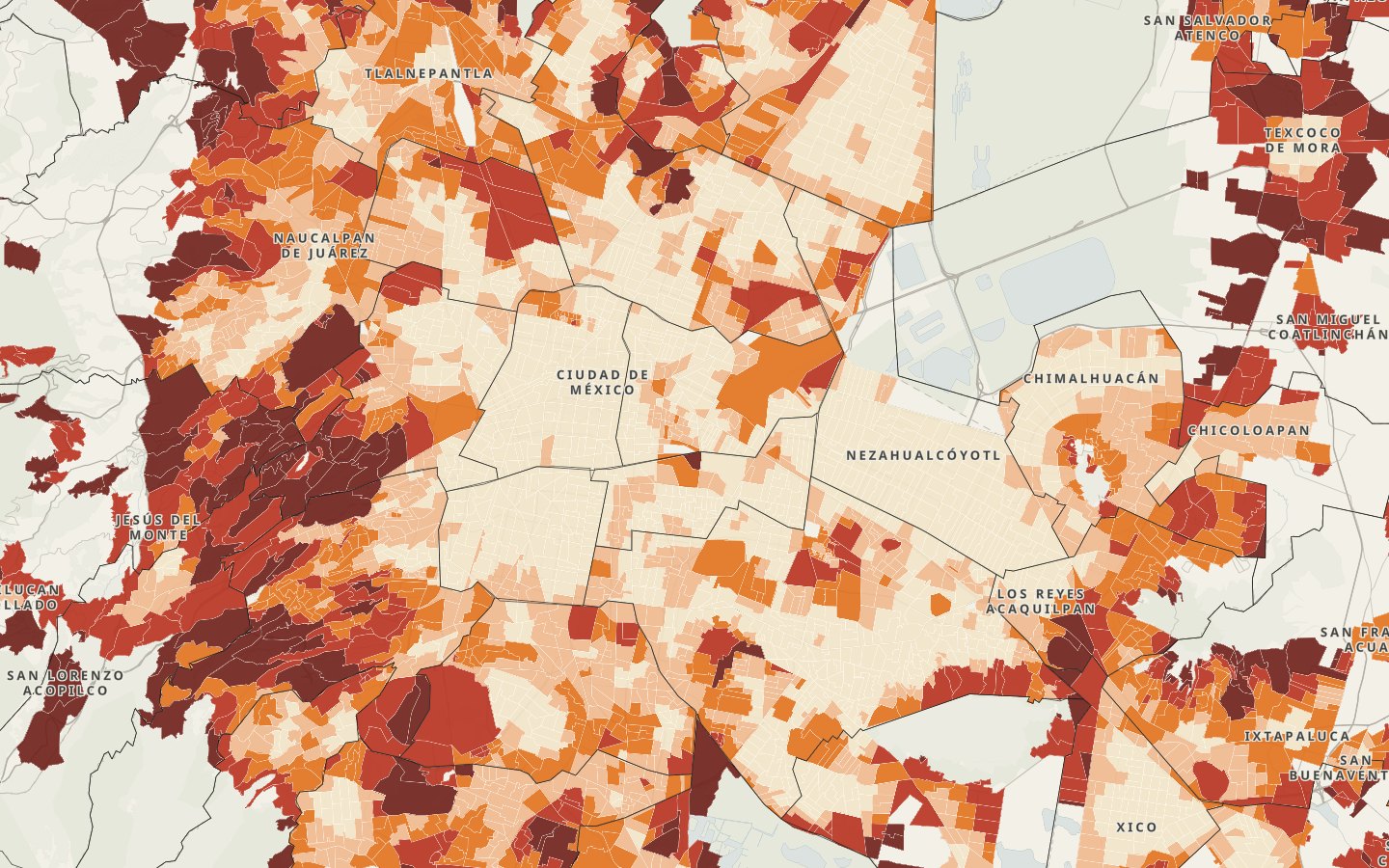
Half of the people in Medellín score 54.5 points or more; in Barranquilla, 40.3. We measured the 12.3 million people of Bogotá, Medellín, Cali and Barranquilla by their walking distance to the nearest place of six everyday functions, with a single scale for all four cities.
Read the technical noteThe first two pages, online. The full note is sent by email on request.
The problem
Measuring the country’s four most populous cities the same way shows where everyday life is far away, which function is missing in each neighborhood and where new housing can go close to what already exists. The full research, with the method, the location validation and Bogotá in depth, is on the index microsite.
What we found
Each city lacks something different close to home
According to official inventories, in Bogotá 45% of the people have no public health facility within a fifteen-minute walk and 43% have no cultural facility; in Barranquilla, 59% have no cultural facility and one in three people has no official transit stop. In Medellín and Cali the gap is smaller: between 18% and 26% of the people have no public health facility or cultural facility that close. Knowing what is missing in each city helps decide what to build first.
It cannot be said which city ranks first
In the main version, with official inventories, Medellín scores 52.5 and Bogotá 51.2: a small difference. If only OpenStreetMap is used, the order reverses and Bogotá moves to first place. What holds with any source is which cities are at the extremes, not the order between the top two.
What lies farthest away is what the State provides
Of the six functions measured, public health and culture are the farthest away in almost every city. In Bogotá, 45% of the people have no public health facility within a fifteen-minute walk, above all in Suba and Kennedy. Closing that gap depends on where the public sector decides to build, not on the market.
Bogotá builds more where everything is far away
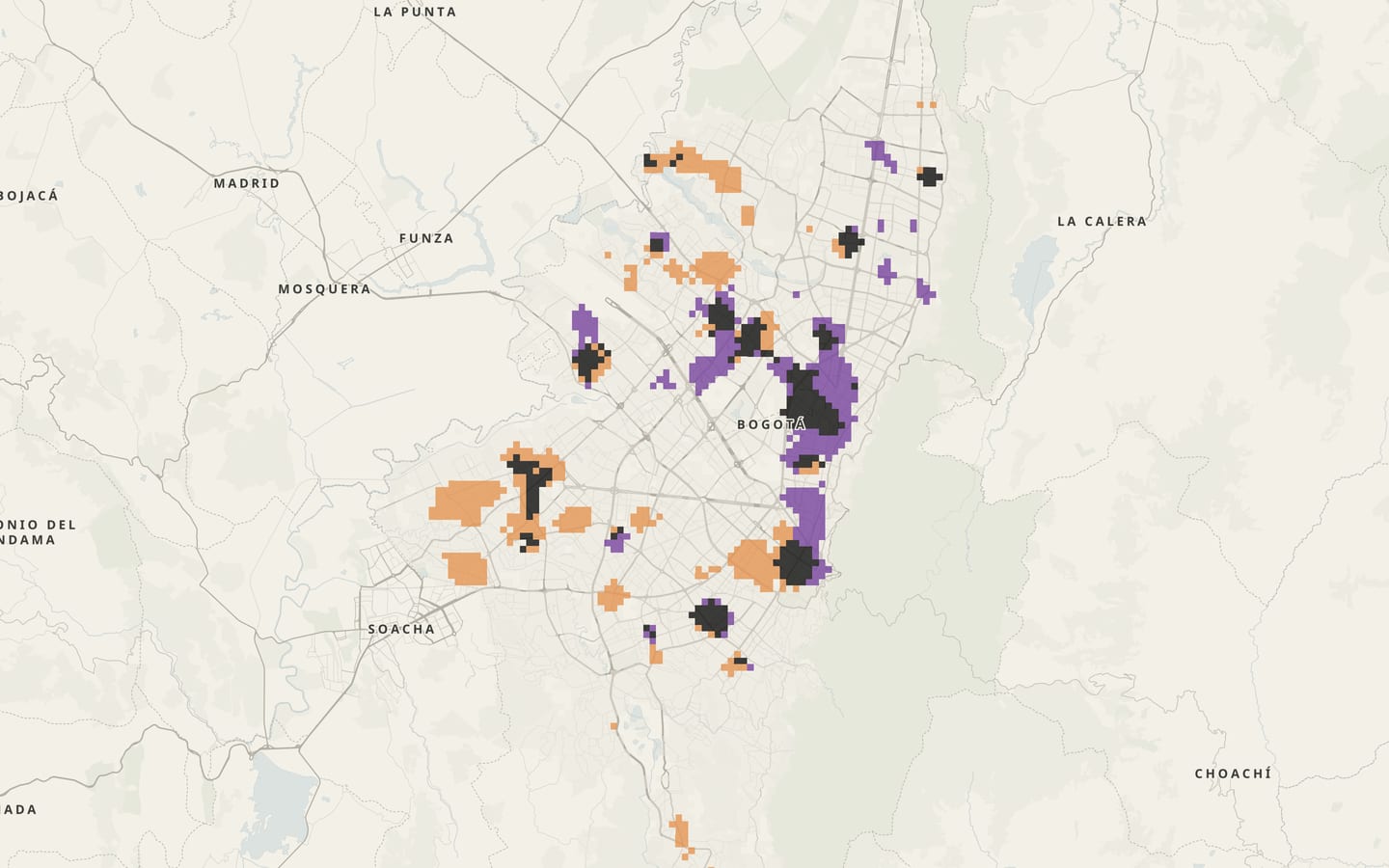
Between 2016 and 2026, 23.5% of the m² built in Bogotá went to the quintile with the least proximity, where 14.5% of the people live. There, 8.0 new m² were built per person, twice as much as in the quintile with the most proximity: the city grows fastest precisely where services are farthest away.
See it on the map
More from this project Full research on the index · Measure your neighborhood
Modeling of walking trips, index of the four cities, cross-reading with Bogotá’s cadastre and crashes, and map narrative · Colombia · Bogotá, Medellín, Cali and Barranquilla · 2026
Facing a similar problem?
We can run this analysis for your city, with your data and your question.
Relevant for
- Mobility and planning departments
- Road-safety and school-mobility programs
- Care and social-development programs
- International organizations and funders