Back to Mobility and Accessibility
An hour by bus, a third of the city
What can be reached in 60 minutes of public transit at rush hour, city block by city block.
One Hour on Public Transit · Bogotá · How much of Bogotá can be reached in an hour of public transit?
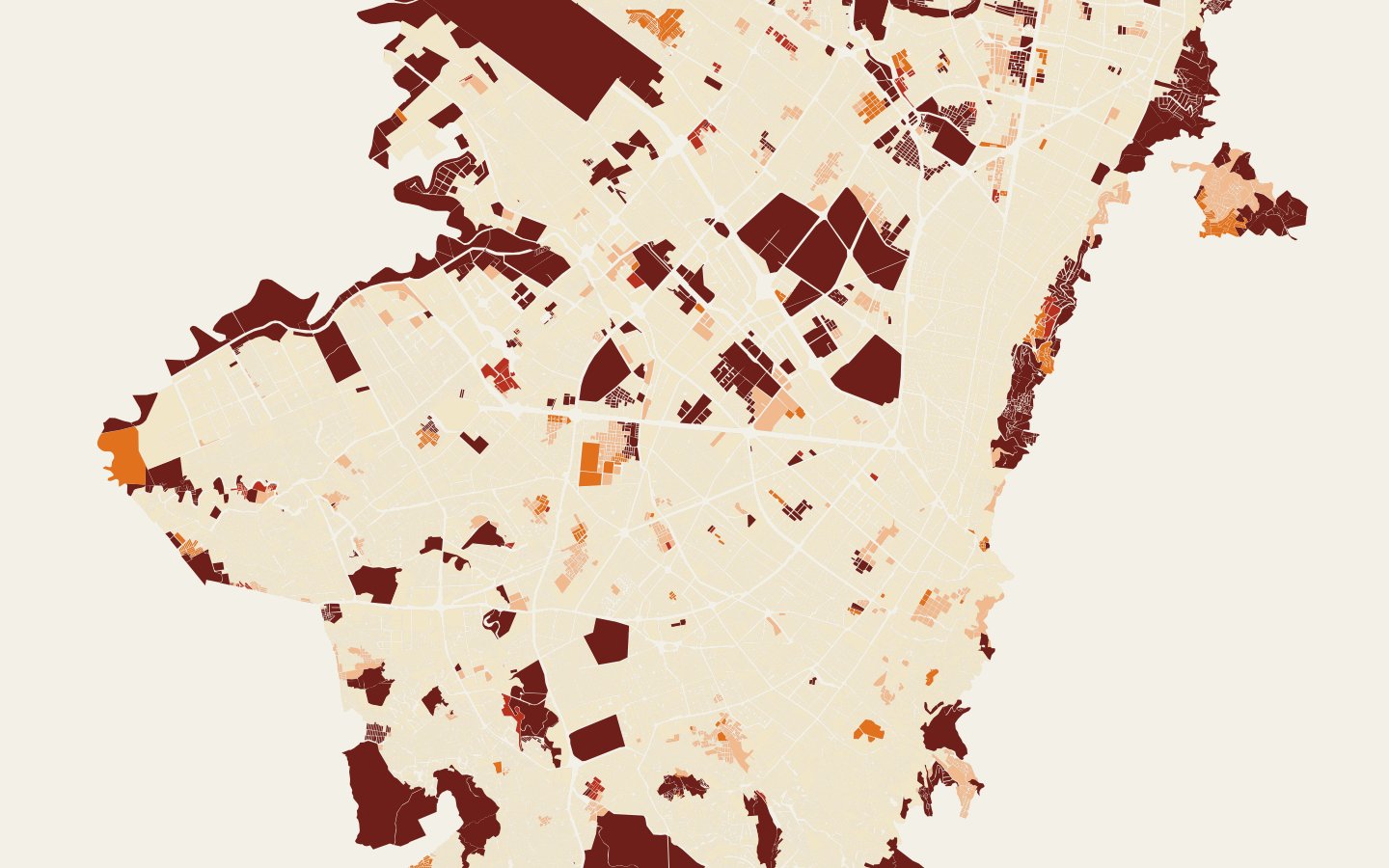
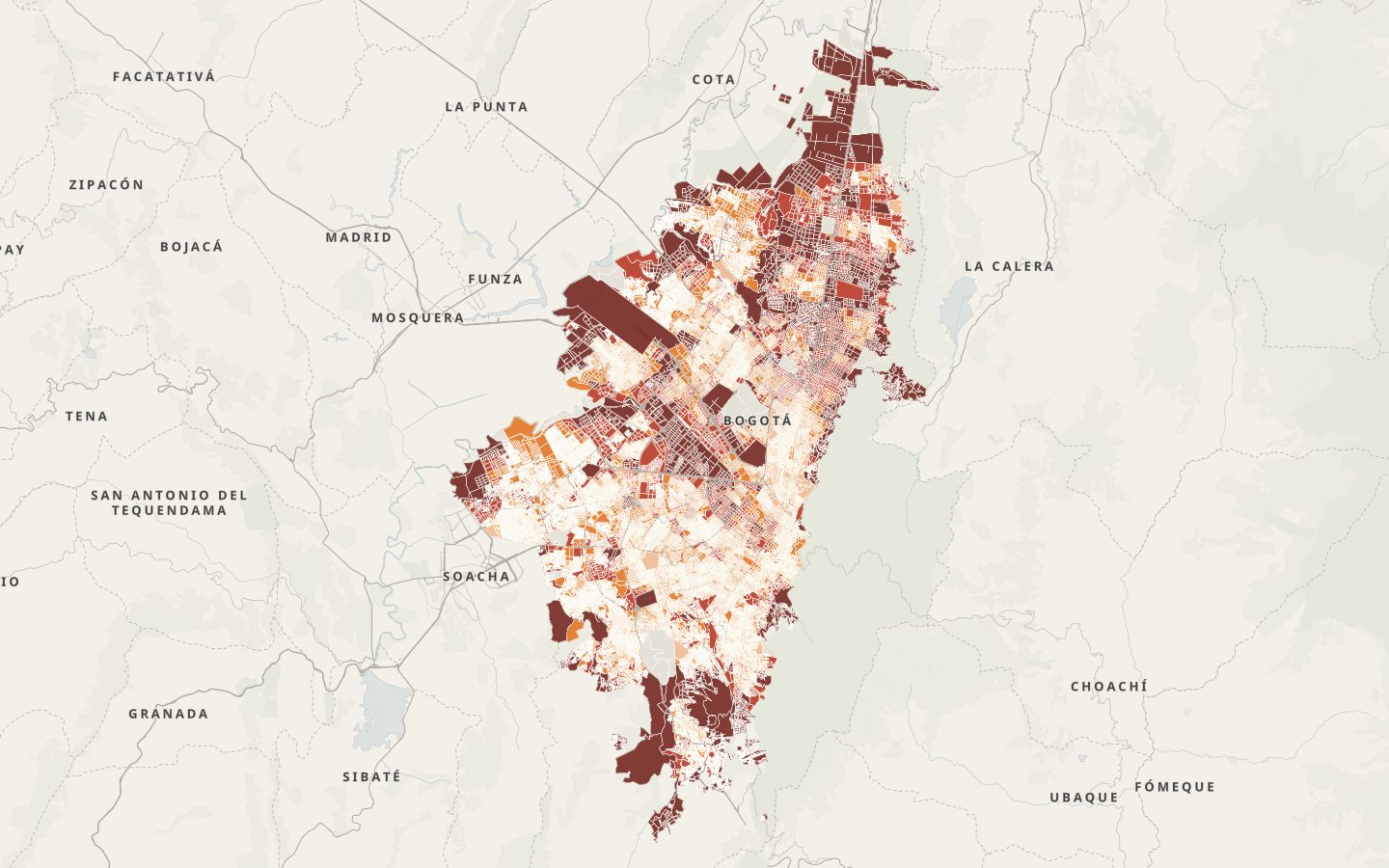
In 60 minutes of public transit at rush hour, the median person reaches city blocks where 30% of Bogotá’s population lives; on foot, in the same hour, 9.9%. Commercial floor area is the most unequal: the 10% with the least reach get to less than 5.7%, and the 10% with the most, to more than 72.4%.
Read the technical noteThe first two pages, online. The full note is sent by email on request.
The problem
What is not within walking distance has to be reached by transit. Measuring how much city fits in an hour of bus and walking shows how large, in practice, each person’s city is.
What we found
In an hour of public transit, almost no one reaches half the city
For each person we counted how much of Bogotá’s population lives in the city blocks they reach in 60 minutes of public transit and walking, leaving in the morning. Only 2.7% of the people reach city blocks where more than half of the city’s population lives.
Having services within walking distance does not guarantee getting around well by public transit
Only 28% of the people are in the same quintile for walking proximity and for transit reach: they are two different measures. 570,357 people are in the worst quintile on both, mostly in Suba, Usaquén and Usme.
Where the trunk lines meet, an hour reaches much more of the city
From Puente Aranda, an hour reaches on average 46.5% of Bogotá’s population; from Tunjuelito, 45.5%, and from Los Mártires and Antonio Nariño, 44.3%. From Usme it reaches 17.5%, and from Usaquén, 18.2%.
Almost everyone reaches public health care by transit within half an hour, except in Usme
By public transit, only 6.2% of the people take more than 30 minutes to reach a public health facility. In Usme it is 60.5% of residents: there, public health care is far away on foot and by bus as well.
The network multiplies walking
Within 15 minutes on foot, people reach on average 0.8% of the city’s population; within 60 minutes on foot, 9.9%, and with 60 minutes of transit and walking, 30.7%.
Transit offsets part of the disadvantage
Between the lowest and highest walking-proximity quintiles, the reach ratio falls from 1.83 on foot to 1.46 by transit. Quintile 1 still lags: it reaches 23.7% of the population in an hour, against 34.6% for quintile 5.
Bosa and Ciudad Bolívar reach many people and little retail
Of the floor area in retail and offices, the median person reaches 26.6% in an hour; the bottom 10%, less than 5.7%. From Bosa and Ciudad Bolívar people reach a large population, but mostly residential neighborhoods like their own.
See it on the map
What we recommend
Treat walking proximity and transit reach as two policies: neighborhood services where proximity is missing and trunk or express connections for the northern and southern edges, starting with the people at a disadvantage on both measures, mainly in Suba, Usaquén and Usme.
The transit network greatly expands what each person can reach, but it does not share it out evenly.
Public transit routing for every city block, comparison with walking proximity · Bogotá, Colombia · 2026
Facing a similar problem?
We can run this analysis for your city, with your data and your question.
Relevant for
- Mobility and planning departments
- Road-safety and school-mobility programs
- Care and social-development programs
- International organizations and funders